
App-only / Note
Indonesia’s skincare market is crowded. Yet Skintific managed to become one of the most visible brands in the category remarkably quickly. The more useful question is not whether the brand is popular. It is: What did Skintific get right about modern consumer distribution?
Neverlater
September 7, 2026
Shape your Neverlater
Follow the topics behind this signal
Following immediately improves For You, Daily Brief, and Notifications.
App-only note
Skintific’s rise in Indonesia is difficult to miss.
Compas data shows the brand led Shopee Indonesia’s beauty-and-care category in Q1 2025 with a 4.10% share, ahead of Wardah and Glad2Glow.
By Q1 2026, Skintific also ranked first in facial moisturizers on Shopee with a 7% market share.
It led facial-serum sales on Shopee in Q4 2025 with 5.58%, and beauty-package sales with 5.99%.
That is not dominance of the entire Indonesian beauty market.
But it is meaningful digital traction.
So what worked?
Beauty can become complicated quickly.
Ingredients.
Claims.
Routines.
Skin types.
Skintific built much of its communication around clear problems and recognizable product propositions.
Barrier repair.
Ceramide.
Acne.
Brightening.
Sunscreen.
Consumers do not need to understand the entire science.
They need to understand what problem the product is solving.
That simplicity travels extremely well across TikTok, marketplace thumbnails, creator content, and paid media.
A broad portfolio can look impressive.
But hero products create focus.
One memorable moisturizer can do more for awareness than 40 average SKUs.
creators something specific to talk about,
consumers something easy to remember,
marketplaces a clear conversion engine,
and retailers a reason to allocate shelf space.
Skintific’s ability to build highly visible moisturizer, cushion, serum, and bundle propositions appears to have helped create that effect.
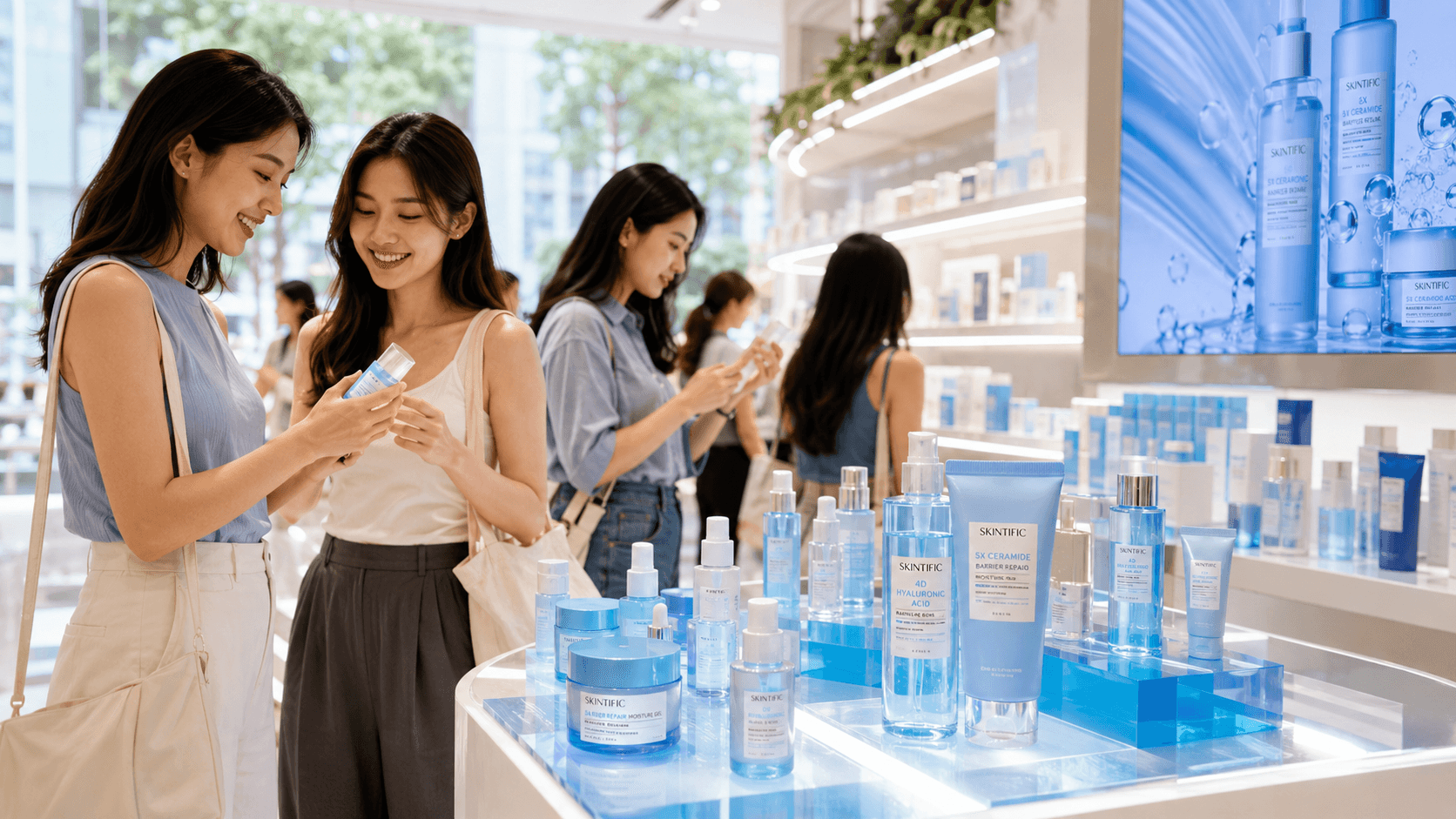
Skintific is available across Shopee, TikTok, Lazada and Tokopedia in Indonesia, while its offline distribution includes Watsons, Guardian, Sociolla, Beautyhaul, Boots and Miniso.
That mix matters.
Marketplaces are no longer simply checkout infrastructure.
search engines,
advertising platforms,
review systems,
affiliate networks,
and discovery environments.
A modern beauty brand needs to win inside all of those layers.
There is another factor that should not be ignored.
Skintific is highly promotional.
Its official Indonesian site and marketplace stores frequently show significant discounts and bundle offers.
That helps acquisition.
But it creates a longer-term question.
Can the brand maintain demand when the consumer no longer needs a discount to try it?
That is where digital traction needs to become brand equity.
This may be the next phase.
Beauty increasingly benefits from omnichannel reinforcement.
TikTok creates awareness.
Shopee creates conversion.
Watsons or Sociolla creates physical validation.
Consumers can touch.
Test.
Compare.
Ask.
The channels reinforce one another.
This is how a digital-native brand starts feeling like a mainstream consumer brand.
Skintific’s rise looks less like a single marketing success and more like a distribution system working together.
Clear products.
Hero SKUs.
Creators.
Marketplace conversion.
Aggressive promotion.
Offline availability.
Each piece amplifies the others.
That is probably the larger lesson.
Modern consumer brands do not win one channel at a time. They build a system where discovery, conversion, proof, and availability reinforce one another.
The harder question comes next.
Skintific has won attention.
Now it needs to prove that attention can become durable preference.
References
Sources used to support this Neverlater read.
Discussion
No approved comments yet. Be the first to add a thoughtful note.