App-only / Note
Blibli is still usually described as an Indonesian e-commerce company. That description is becoming increasingly incomplete. By the end of June 2026, the Blibli ecosystem included: - 326 consumer-electronics stores - 14 home-appliance stores - 60 premium supermarkets - 38 Dekoruma home-and-living experience centres - tiket.com - 15 warehouses covering roughly 200,000 sqm - 19 distribution hubs - A logistics network capable of offering two-hour delivery across more than 40 cities for over 400,000 SKUs. H1 2026 consolidated net revenue grew 55% to Rp14.83 trillion, while physical-store revenue grew 41%. Blibli also narrowed its EBITDA deficit materially. So perhaps the more interesting question is no longer: Can Blibli win e-commerce? It is: Can Blibli build something more valuable by becoming a broader consumer operating system?
Neverlater
August 26, 2026
Shape your Neverlater
Follow the topics behind this signal
Following immediately improves For You, Daily Brief, and Notifications.
App-only note
Indonesia’s marketplace battle has been brutal.
Traffic can be bought.
Promotions can be copied.
Sellers can multi-home.
Prices can be compared instantly.
Consumers can switch apps in seconds.
That makes pure marketplace differentiation difficult.
Blibli appears to have taken a different path.
Instead of becoming more marketplace-like, it has increasingly built assets that are harder to replicate.
Blibli’s H1 2026 physical-store revenue grew 41% YoY.
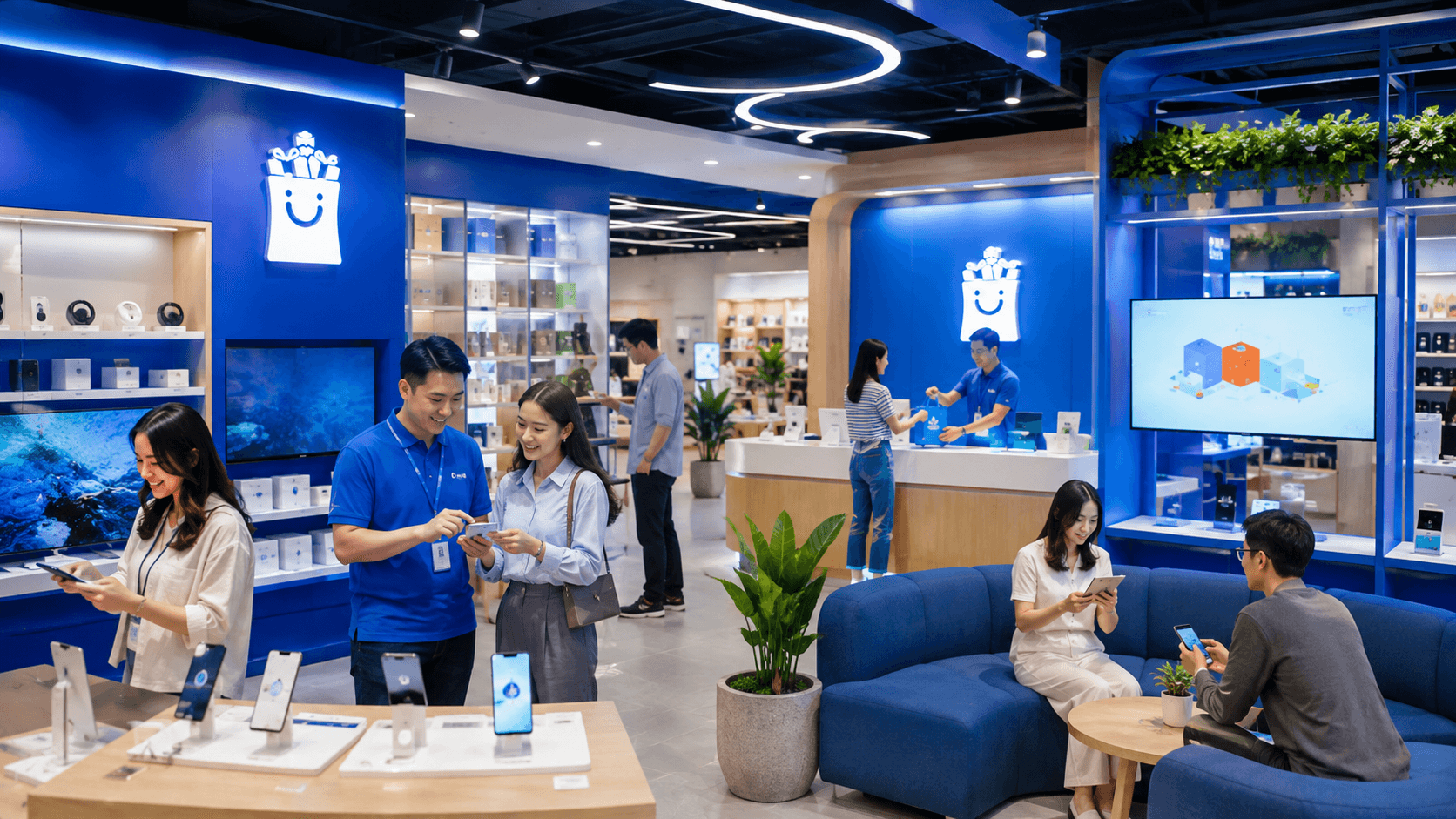
By June, its physical network included 326 consumer-electronics stores, 14 home-appliance stores, one fashion and sports store and 60 premium supermarkets through Ranch Market.
This matters because physical stores create capabilities that a digital marketplace alone does not.
Stores are not the opposite of e-commerce.
They can become another part of fulfilment.
Blibli now spans several major consumption categories.
General commerce.
tiket.com
Travel and experiences.
Premium grocery.
Home and living.
electronics → groceries → travel → home → lifestyle.
Those categories have very different economics.
That is precisely why integration is difficult.
But it is also why integration can become valuable.
Blibli operates 15 warehouses covering around 200,000 sqm and 19 distribution hubs.
The company says this infrastructure enables two-hour delivery for more than 400,000 SKUs across 40+ cities. It also launched a “Prioritas” service offering delivery starting from 30 minutes after payment.
That begins to look less like marketplace infrastructure and more like retail infrastructure.
The distinction matters.
A marketplace primarily connects buyers and sellers.
Blibli is increasingly doing both.
The marketplace model is attractive because inventory risk can sit with third-party sellers.
Blibli’s growing first-party and physical-store businesses change that.
This is a deliberate trade.
Blibli appears increasingly willing to sacrifice some asset-light purity for greater control.
Consumer electronics can generate large baskets.
But people do not buy smartphones every week.
Grocery is different.
Ranch Market gives Blibli exposure to a much higher-frequency category.
At the end of June, the ecosystem managed 60 premium supermarket outlets, and management said supermarket margins and same-store sales had improved during the period.
If Blibli can meaningfully integrate grocery behaviour into the broader ecosystem, it could change customer frequency.
That is strategically important.
tiket.com gives Blibli something very different from retail.
Travel.
At June 2026, tiket.com offered flights from 151 airlines, more than 3.6 million accommodation options, approximately 112,000 activities and destinations, and more than 4,500 events globally.
Travel is not naturally synergistic with selling electronics.
But customer identity, loyalty, payments and rewards can create a connective layer.
This is why unified membership matters more than putting everything inside one app.
Blibli has been developing Blibli Tiket Rewards across Blibli, tiket.com, Ranch Market and Dekoruma.
If that works, the ecosystem does not need every consumer to use every business.
That is the economic argument behind the ecosystem.
The challenge is proving it.
H1 2026 net revenue reached Rp14.83 trillion, up 55% YoY.
Operating expenses as a percentage of TPV fell from 7.2% to 6.3%, while EBITDA as a percentage of TPV improved by 170 basis points to negative 0.8%.
This is encouraging.
But Blibli is not yet at the point where ecosystem complexity can be treated as automatically valuable.
The business still needs to prove that integration ultimately produces better economics.
More assets do not necessarily mean more moat.
Sometimes they simply mean more cost.
Blibli has increasingly positioned itself around a different promise from the open marketplace model:
certainty.
Authentic products.
Reliable fulfilment.
Physical support.
Integrated stores.
Controlled inventory.
The company itself has framed trust and post-transaction certainty as important parts of its evolving proposition.
That may become more important as online commerce matures.
When every platform can offer choice, trust becomes more valuable.
Our view: Blibli may become more strategically interesting the less we think about it as a conventional e-commerce company.
Its opportunity is not necessarily to win the same marketplace game as everyone else.
commerce + stores + grocery + travel + home + logistics + loyalty.
That model is heavier.
More complex.
More capital intensive.
But if the pieces reinforce each other, it could also become significantly harder to replicate.
Can Blibli become Indonesia’s biggest marketplace?
Can Blibli make the whole ecosystem more valuable than the individual businesses would be on their own?
That is a much more interesting test.
Can continued revenue growth and cost discipline push consolidated EBITDA positive?
Are customers genuinely using multiple businesses across Blibli, tiket.com, Ranch Market and Dekoruma?
Does the rapidly expanding store network generate attractive mature-store economics?
Can Ranch Market increase frequency and deepen the broader customer relationship?
Does higher network volume improve warehouse and last-mile economics?
Can Blibli Tiket Rewards materially increase retention and cross-platform behaviour?
How efficiently can Blibli manage the heavier inventory requirements of first-party retail and physical stores?
Can better recommendations and merchandising increase conversion without requiring proportionally higher marketing spend?
References
Sources used to support this Neverlater read.

Discussion
No approved comments yet. Be the first to add a thoughtful note.