M&A, Functional Nutrition, Better-for-YouDanone, MADE Group, Rokeby, Cocobella, The CollectiveAustralia, New Zealand, Southeast Asia, and wider Asia-Pacific
Danone has agreed to acquire MADE Group as part of its effort to strengthen its healthy-nutrition portfolio across Asia-Pacific.
Following immediately improves For You, Daily Brief, and Notifications.
01
Signal
Danone has agreed to acquire MADE Group as part of its effort to strengthen its healthy-nutrition portfolio across Asia-Pacific.
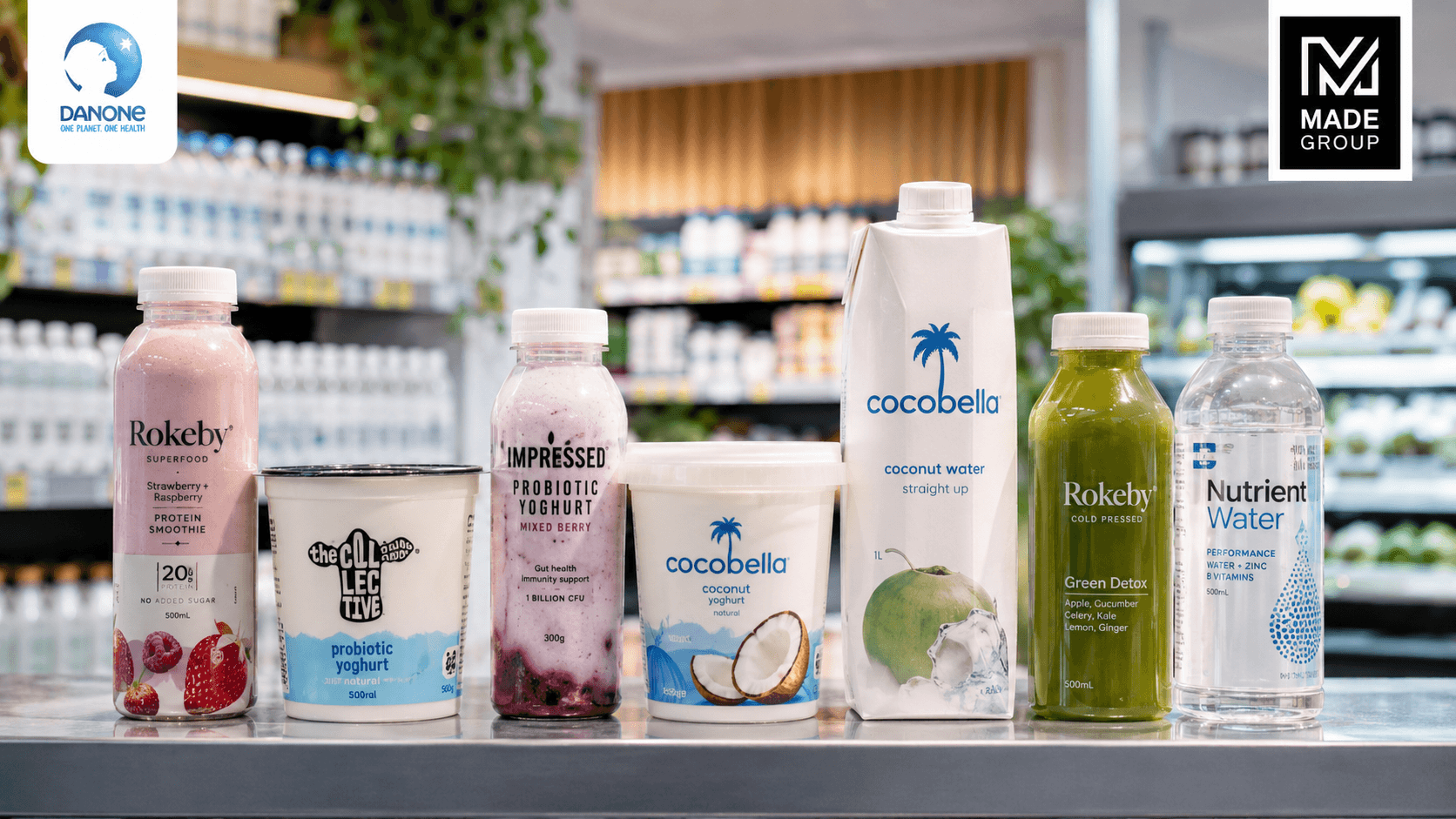
MADE is an Australia-based food and beverage company with a portfolio spanning:
High-protein ready-to-drink products
Probiotic and gut-health yoghurt
Coconut water and coconut yoghurt
Cold-pressed juice
Enhanced water
Other health-oriented everyday products
Its brands include Rokeby, Cocobella, The Collective, Impressed, and NutrientWater.
MADE recorded more than €300 million in sales for the fiscal year ending June 2026. Danone said the company has consistently delivered double-digit growth and attractive margins, supported by established supply-chain and route-to-market capabilities.
Reuters reported that demand for high-protein yoghurt is growing strongly in Australia and New Zealand, where Danone currently has limited exposure to the segment. MADE is also expanding across Southeast Asia, where management sees it as an early mover in protein-led products.
Danone expects the acquisition to contribute positively to its operating margin and earnings per share from the first year after completion. The transaction value has not been disclosed.
The deal is expected to close in the second half of 2026, subject to regulatory approvals and other customary conditions.
02
Why it matters
At first glance, this looks like a large food company buying a collection of health-oriented beverage and dairy brands.
But the strategic signal is broader.
For years, protein was marketed mainly through:
Powdered supplements
Protein bars
Performance shakes
Sports-nutrition products
Specialist meal replacements
These formats often require consumers to adopt a separate routine.
MADE’s portfolio reflects a different approach.
Rokeby sells protein through ready-to-drink smoothies, probiotic yoghurt, and functional milk. The Collective operates inside the familiar yoghurt aisle. Cocobella builds around coconut water and yoghurt. These are recognisable food and beverage occasions rather than specialist supplement formats.
That distinction matters commercially.
A supplement asks consumers to begin a new behaviour.
An everyday food product can upgrade a behaviour that already exists.
Instead of asking someone to begin mixing protein powder every morning, a brand can offer a higher-protein version of the drink, yoghurt, snack, or breakfast product they already consume.
The behavioural barrier is lower because the format is already familiar.
The deal therefore supports a broader category shift:
Protein is becoming less of a standalone category and more of a functional attribute across everyday food.
03
Neverlater read
Our view: Danone is not only acquiring a portfolio of healthy food and beverage brands.
It is acquiring proof that protein and functional nutrition can move into familiar daily consumption.
The opportunity is not necessarily to convince the entire mass market to shop like athletes.
It is to make everyday food slightly more useful.
That could mean:
A yoghurt that delivers more protein
A bottled drink that feels more filling
A breakfast product that provides more complete nutrition
A snack that supports satiety
A convenient meal with a stronger nutritional profile
An indulgent product that feels less nutritionally empty
This is strategically attractive because protein can address several consumer needs at once.
Depending on the product and audience, it can be associated with:
Exercise and recovery
Satiety
Weight management
Healthy ageing
Muscle maintenance
Convenient nutrition
Breakfast replacement
Everyday wellness
That gives protein broader commercial flexibility than many functional ingredients.
Consumers may not understand every difference between whey, casein, soy, pea, or other protein sources.
But the word protein already carries meaning.
04
What to watch next
Familiar Formats Can Expand the Market
Rokeby’s protein smoothies are a useful example.
The consumer does not need a blender, shaker bottle, or knowledge of supplement preparation.
They can buy a bottle and consume it like any other ready-to-drink beverage.
That convenience may help explain why large food companies are increasingly interested in functional-nutrition formats that sit between specialist supplements and conventional FMCG.
Danone’s recent portfolio moves support that direction.
The company announced an agreement to acquire complete-nutrition brand Huel in March 2026, after completing the acquisition of a majority stake in plant-based medical and everyday-nutrition company Kate Farms in 2025. MADE adds a more conventional retail and everyday-food layer to that wider nutrition strategy.
The combination is commercially interesting:
Huel adds complete nutrition and digital capabilities
Kate Farms adds specialised and medical nutrition
MADE adds familiar functional food and beverage formats
Danone adds research, manufacturing, distribution, and regional scale
The wider bet appears to be that nutrition will increasingly sit across multiple levels of consumer behaviour, from specialist need to everyday consumption.
Southeast Asia Will Require a Different Playbook
The opportunity should not be copied directly from Australia, Europe, or the United States.
No approved comments yet. Add the first thoughtful note.
Brands generally do not need to begin by explaining why it matters.
The harder part is product execution.
Protein Is an Attribute, Not the Full Proposition
A product does not become compelling simply because protein has been added.
The product still needs to answer:
Why should someone consume it?
At which moment of the day?
What existing alternative does it replace?
Is the protein amount meaningful?
Does the product still taste good?
Is the price acceptable for repeat purchase?
“High protein” can help the proposition.
It cannot replace one.
A successful product still needs a clear consumer job.
For example:
Breakfast: quick, filling, and convenient.
Afternoon snack: satisfying enough to reduce hunger before dinner.
Post-workout: portable nutrition without preparation.
Convenient meal: better nutritional value than the typical quick option.
Indulgence: enjoyment with a more credible functional benefit.
The strongest protein products will probably start with the occasion, not the ingredient.
Familiar Formats Can Expand the Market
Rokeby’s protein smoothies are a useful example.
The consumer does not need a blender, shaker bottle, or knowledge of supplement preparation.
They can buy a bottle and consume it like any other ready-to-drink beverage.
That convenience may help explain why large food companies are increasingly interested in functional-nutrition formats that sit between specialist supplements and conventional FMCG.
Danone’s recent portfolio moves support that direction.
The company announced an agreement to acquire complete-nutrition brand Huel in March 2026, after completing the acquisition of a majority stake in plant-based medical and everyday-nutrition company Kate Farms in 2025. MADE adds a more conventional retail and everyday-food layer to that wider nutrition strategy.
The combination is commercially interesting:
Huel adds complete nutrition and digital capabilities
Kate Farms adds specialised and medical nutrition
MADE adds familiar functional food and beverage formats
Danone adds research, manufacturing, distribution, and regional scale
The wider bet appears to be that nutrition will increasingly sit across multiple levels of consumer behaviour, from specialist need to everyday consumption.
Southeast Asia Will Require a Different Playbook
The opportunity should not be copied directly from Australia, Europe, or the United States.
Southeast Asian markets differ materially in:
Purchasing power
Taste preferences
Dairy consumption
Cold-chain availability
Retail fragmentation
Cultural eating habits
Portion expectations
Price sensitivity
A premium bottled protein smoothie may perform well among urban consumers.
But it may not become the largest local format.
The more scalable Southeast Asian opportunity could emerge through products such as:
Yoghurt drinks
Milk or soy beverages
Protein-enriched snacks
Nuggets and convenient protein foods
Noodles with improved nutritional content
Ready-to-eat chicken or egg products
Frozen meals
Affordable breakfast products
Functional desserts
Local products built around soy, mung beans, tempeh, eggs, fish, or dairy
The winning format may not look like a Western sports-nutrition product.
It may look like an ordinary local food with a better nutritional profile.
Taste and Price Will Still Decide the Category
Functional products often attract trial because of the claim.
Repeat purchase usually comes from taste, convenience, and value.
Protein can create several product-development challenges.
It can affect:
Texture
Thickness
Flavour
Smell
Aftertaste
Shelf life
Production cost
It can also create a price problem.
A product may be technically strong but commercially narrow if the protein content pushes the price too far above the standard alternative.
This matters especially in Indonesia and Southeast Asia, where many consumers may like the nutritional proposition but remain unwilling to pay a large recurring premium.
The real opportunity is not to add the maximum possible protein.
It is to find the right balance between meaningful nutrition, strong taste, affordability, and commercial margin.
Our Conviction
The next phase of protein will not be won only inside supplement stores.
It will increasingly be won in the yoghurt aisle, the beverage fridge, the snack shelf, the frozen-food section, and the everyday meal.
The strongest brands may not ask consumers to build a new routine around nutrition.
They may improve the routine consumers already have.
Danone’s acquisition of MADE Group is one of the clearest corporate signals that large food companies see that opportunity developing across Asia-Pacific.
Purchasing power
Taste preferences
Dairy consumption
Cold-chain availability
Retail fragmentation
Cultural eating habits
Portion expectations
Price sensitivity
A premium bottled protein smoothie may perform well among urban consumers.
But it may not become the largest local format.
The more scalable Southeast Asian opportunity could emerge through products such as:
Yoghurt drinks
Milk or soy beverages
Protein-enriched snacks
Nuggets and convenient protein foods
Noodles with improved nutritional content
Ready-to-eat chicken or egg products
Frozen meals
Affordable breakfast products
Functional desserts
Local products built around soy, mung beans, tempeh, eggs, fish, or dairy
The winning format may not look like a Western sports-nutrition product.
It may look like an ordinary local food with a better nutritional profile.
Taste and Price Will Still Decide the Category
Functional products often attract trial because of the claim.
Repeat purchase usually comes from taste, convenience, and value.
Protein can create several product-development challenges.
It can affect:
Texture
Thickness
Flavour
Smell
Aftertaste
Shelf life
Production cost
It can also create a price problem.
A product may be technically strong but commercially narrow if the protein content pushes the price too far above the standard alternative.
This matters especially in Indonesia and Southeast Asia, where many consumers may like the nutritional proposition but remain unwilling to pay a large recurring premium.
The real opportunity is not to add the maximum possible protein.
It is to find the right balance between meaningful nutrition, strong taste, affordability, and commercial margin.
Our Conviction
The next phase of protein will not be won only inside supplement stores.
It will increasingly be won in the yoghurt aisle, the beverage fridge, the snack shelf, the frozen-food section, and the everyday meal.
The strongest brands may not ask consumers to build a new routine around nutrition.
They may improve the routine consumers already have.
Danone’s acquisition of MADE Group is one of the clearest corporate signals that large food companies see that opportunity developing across Asia-Pacific.

Discussion
No approved comments yet. Add the first thoughtful note.