Radar Signal
Our Read on Sappun’s Indonesia First Expansion
South Korean women’s footwear brand Sappun has chosen Indonesia as the starting point for its international retail expansion.
Neverlater Radar / July 24, 2026
Shape your Neverlater
Radar Signal
South Korean women’s footwear brand Sappun has chosen Indonesia as the starting point for its international retail expansion.
Neverlater Radar / July 24, 2026
Shape your Neverlater
Follow the topics behind this signal
Following immediately improves For You, Daily Brief, and Notifications.

Signal
South Korean women’s footwear brand Sappun has chosen Indonesia as the starting point for its international retail expansion.
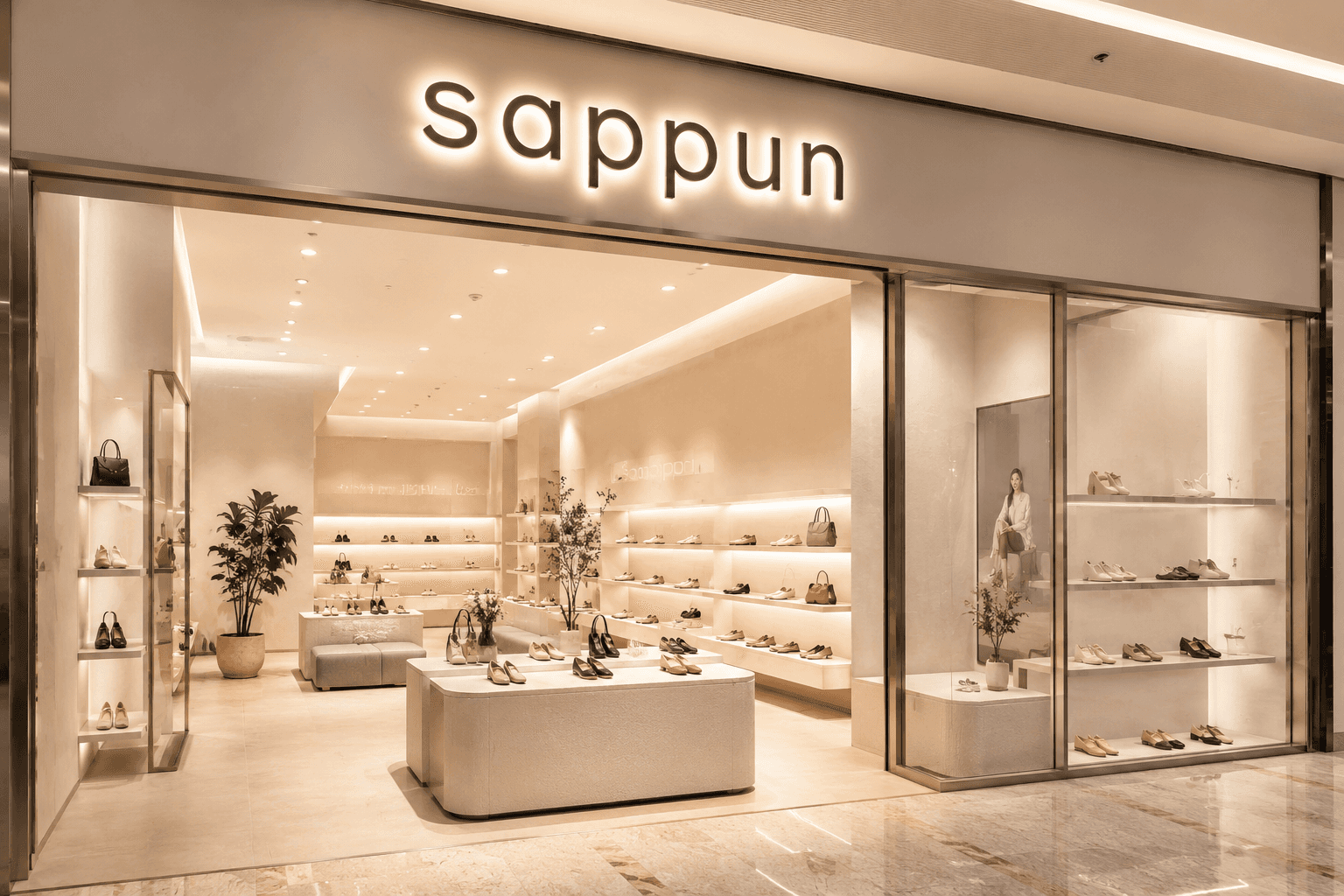
The company has already opened five monobrand stores and is targeting a network of 30 Indonesian stores within five years.
But the more important question is not how quickly Sappun can open stores.
It is whether Indonesia can become a repeatable operating base for the brand’s wider Southeast Asian expansion.
Sappun is expanding into Southeast Asia through Indonesia, marking what the company describes as the first overseas expansion of a Korean women’s footwear brand.
The Korean label is operated by FNS Retail and entered Indonesia through an exclusive partnership with Surya Bumi Retailindo, a local retail operator that manages more than 20 international brands across sports, fashion, and lifestyle categories.
The partnership gives Surya Bumi Retailindo exclusive distribution rights for Sappun in Indonesia and establishes the foundation for longer-term retail expansion.
Sappun has opened standalone stores across major Indonesian shopping destinations, including:
The brand has also expanded through shop-in-shop formats at Central Department Store and Sogo. Its current Indonesian store directory lists locations across Jakarta, Bandung, Bekasi, and Surabaya.
According to Inside Retail Asia, sales at its early Indonesian stores were comparable to Sappun’s flagship locations in South Korea.
The company plans to build a network of 30 stores in Indonesia within five years, while also preparing to enter Vietnam.

Why it matters
This is not simply another Korean fashion brand opening stores in Indonesia.
Sappun is using Indonesia as the first test of whether its brand and retail format can travel internationally.
That makes the expansion strategically interesting for several reasons.
For Sappun, entering through a local partner reduces the need to build every capability internally.
That gives Sappun a faster route into the market.
But it also makes the quality of the partnership central to the brand’s performance.
The broader signal is that Indonesia is increasingly becoming more than a destination market for Asian consumer brands.
It is also becoming a place where brands test whether their formats can scale across Southeast Asia.
Neverlater read
Our view: Sappun is not only testing demand for Korean footwear in Indonesia.
It is testing whether Indonesia can become the operating foundation for its regional expansion.
The early signals appear encouraging.
Sappun moved quickly from its initial launch into a five-store monobrand network, supported by shop-in-shop distribution and an online presence.
Its reported sales performance, comparable to Korean flagship stores, suggests that Indonesian consumers are responding to the proposition.
But early store momentum does not yet prove durable product-market fit.
The real test begins after the launch period.
Can Sappun build repeat purchases?
Can it expand beyond consumers already interested in Korean fashion?
Can stores remain productive once the novelty fades?
Can the proposition work outside Indonesia’s most premium malls?
These questions matter because footwear behaves differently from high-frequency consumer categories.
Customers do not buy shoes every week.
What to watch next
Sappun’s plan to reach 30 stores within five years is ambitious.
The most important signal will not be the number of openings.
A slower but productive network would be more valuable than rapid expansion with weak store economics.
The current network is concentrated in prominent urban retail locations.
The 30-store target will likely require the brand to move beyond a small group of premium shopping destinations.
Sappun’s Korean identity is part of its attraction.
References
Sources used to support this Neverlater read.
Sappun’s Indonesian positioning is centred on Korean minimalism, everyday comfort, and versatile women’s footwear. Its local website presents the brand as a lifestyle-footwear label designed for regular use rather than only trend-led occasions.
That is a sensible foundation.
But scaling to 30 stores will require more than aesthetic consistency.
It will require a disciplined retail system.
The critical question is whether Sappun can turn cultural relevance into operational repeatability.
Korean brand heat can generate awareness.
It cannot guarantee retention.
The partnership structure is therefore one of the most important parts of the story.
Sappun keeps its Korean identity, product direction, and brand language.
Surya Bumi Retailindo provides the local operating capability.
That model can be highly effective when both sides are clear about their roles.
But it can become weaker if local execution and global brand direction begin to diverge.
Our conviction is that Sappun’s strongest regional path is not to copy its Korean retail model store by store.
It is to preserve the brand’s core identity while allowing the local operating system to adapt format, assortment, channels, and expansion pace to Indonesia.
If Indonesia works, Sappun gains more than a successful market.
It gains a playbook for wider Southeast Asian expansion.
The strongest localisation keeps the brand recognisable while making the product more useful.
Early demand can be driven by novelty.
Long-term value depends on whether customers return for additional styles and collections.
Sappun is present through its Indonesian website, physical stores, department-store formats, and regional e-commerce platforms.
The strongest footwear retailers use stores to support trial and fit, while digital channels widen assortment and convenience.
Sappun has said it plans to launch in Vietnam.
That expansion will show whether Indonesia is a one-market success or the beginning of a repeatable regional model.
The key question is which parts of the Indonesian playbook can travel and which need to be rebuilt.
Surya Bumi Retailindo is central to the Indonesian strategy.
Its ability to manage real estate, merchandising, inventory, people, and digital channels will materially shape Sappun’s performance.
The partnership should therefore be evaluated as part of the business model, not simply as a distribution arrangement.
Discussion
No approved comments yet. Add the first thoughtful note.